
Letters
Published October 10, 2026 · Last Medically Reviewed November 2, 2026
How to get a Letter of Medical Necessity (LMN) online to use my FSA/HSA
Request a Letter of Medical Necessity online from a US-licensed provider. The review is free, there are no appointments, and you can request any day of the week.
Medically Reviewed ContentThis article has been reviewed by Medical Director Michael Rubio, MMSc, PA-C, in accordance with the Skips Editorial Policy to ensure clinical accuracy and evidence-based standards.
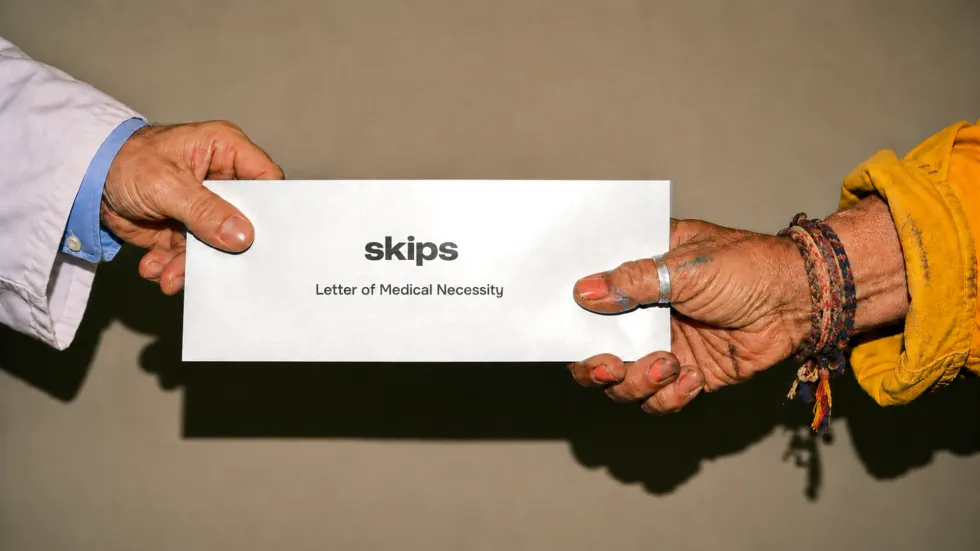
Using your FSA or HSA to cover certain health expenses can feel confusing. Do you need to see a provider in person? Can you get the letter online? What does it cover? How much does it cost?
The short answer: Yes, you can get a Letter of Medical Necessity (LMN) online, right here from this page.
At Skips, the process is straightforward and fully supported by a dedicated provider and care team from start to finish.
Skips providers have written more than 100,000 Letters of Medical Necessity.*
Here’s how it works.
Start your request
This opens a message to a US-licensed provider. Tell them what you need the letter for, in your own words.
1. Check if you’re eligible
First, we’ll check if a Letter of Medical Necessity is suitable for you. The expense must be for medical care, not general wellness or convenience. FSAFEDS and IRS guidance explain when a provider’s certification is needed and which expenses can qualify. Both are listed in References below.
Common examples:
- Massage therapy for chronic low back pain
- Nutrition counseling or a fitness coach for type 2 diabetes
- Gym membership or structured exercise for obesity or sleep apnea
- Standing desk for sciatica pain
- Omega-3 supplements for hypertension
An LMN supports your claim but doesn’t guarantee reimbursement.
2. Start your request
The next step is free and easy. Tell a provider what you need, in your own words. The review is free, and there is no charge if a provider declines. There’s no waiting room and no appointments.
We’ll guide you through gathering the details we need to make sure your Letter of Medical Necessity is accurate and has exactly what your plan needs:
- Your condition and symptoms, relevant history, current medications and allergies
- Severity of your condition, and prior treatments, including the duration of each and your response to each
- Photo ID for an identity match
If your plan has its own form, upload it. We complete the form your plan asked for instead of writing our own letter. FSAFEDS provides an example of an LMN form in References below.
This only takes a few minutes. Skips replies the same day, giving your provider the key information needed to assess whether an LMN is right for you.
Start your request
Have your details ready? Send them to a provider here. The review is free, and there is no charge if a provider declines.
3. Message with your provider
Once your information is gathered, your provider carefully reviews your request. They message with you one-on-one to address your concerns and talk about your goals.
No appointment is necessary. Start a message right away on this page. It is confidential and secure, on your phone or computer.
Skips is open 7 days a week, so you can request any day, weekends included.
4. Your LMN and personalized care plan
If your provider confirms an LMN is right for you, they will create your personalized LMN on official letterhead. Your LMN will include:
- Patient: full name, date of birth
- Provider: name, credentials, NPI, signature, date
- Diagnosis: condition name, ICD-10 code (when applicable), prior treatments, severity, duration, treatment responses, as well as other underlying health issues
- Treatment requested: specific item or service with dose, frequency and duration
- Medical necessity statement: why it’s needed for your condition (meets the “but-for” test)
- Valid for up to 12 months
The “but-for” test is a tax phrase. An expense passes the test when the person would not have bought the item but for their medical condition. So a gym membership passes only when the person would not have paid for it without their diagnosed condition.
You’ll receive your LMN as a PDF.
Final reimbursement decisions are made by your plan.
Start your request
Want a letter like this? Ask a provider here. They review your request and decide whether a letter is right for you.
5. Ongoing support and follow-up
Your care doesn’t end when you receive your LMN.
With Skips Unlimited Membership, you can message a provider any day of the week. If your plan asks for changes, your provider updates the letter at no extra cost while your membership is active.
Getting your Letter of Medical Necessity online is simple, fast, and reviewed by a US-licensed provider.
How much does it cost?
We are only able to write your letter once you have joined, because joining establishes the ongoing medical relationship the letter requires. The $30 membership is charged when a provider approves your letter.
Membership is $30 a month, and members enjoy unlimited consults, prescriptions, refills and lab tests with no extra fees, including unlimited letters of medical necessity.
If you only need this one letter, that is completely fine. You can cancel anytime and your membership stays active to the end of the current cycle, with no cancellation fees.
Your letter will be posted to your member account at member.joinskips.com within 15 minutes of payment.
Start your request
Still reading? You can start your request at any point. A provider reviews it for free.
References
- What expenses are eligible for reimbursement only if medically necessary? FSAFEDS. Accessed November 2, 2026. https://www.fsafeds.gov/
support/ faq/ all/ 16 - Frequently asked questions about medical expenses related to nutrition, wellness and general health. Internal Revenue Service. Accessed November 2, 2026. https://www.irs.gov/
individuals/ frequently- asked- questions- about- medical- expenses- related- to- nutrition- wellness- and- general- health - Other Forms. FSAFEDS. Accessed November 2, 2026. https://www.fsafeds.gov/
file/ forms - Medically necessary. HealthCare.gov. Accessed November 2, 2026. https://www.healthcare.gov/
glossary/ medically- necessary/ - Publication 969 (2025), Health Savings Accounts and Other Tax-Favored Health Plans. Internal Revenue Service. Accessed November 2, 2026. https://www.irs.gov/
publications/ p969
FAQs
Why do I need a membership?
We are only able to write your letter once you have joined, because joining establishes the ongoing medical relationship the letter requires. The $30 membership is charged when a provider approves your letter. You can cancel anytime and your membership stays active to the end of the current cycle, with no cancellation fees.
What is a Letter of Medical Necessity (LMN)?
A provider-signed statement confirming an item or service is needed to prevent or treat a diagnosed condition. It is required when an expense could be for general wellness.
Do I submit my LMN to my HSA now, or just keep it?
For HSAs, you generally keep the LMN with your tax records and use it if you’re ever audited. The IRS says to keep records supporting HSA distributions. HSA custodians typically don’t pre-approve whether a withdrawal is qualified. This is different from an FSA, which usually requires you to submit the LMN (and other documentation) to the plan for payment or reimbursement. Some HSA providers may ask for documents to help you maintain records, but the responsibility is on you, not the plan.
What if my FSA needs edits?
Your provider updates the LMN at no extra cost while your membership is active.
Can I reimburse myself later for something I paid out of pocket?
Yes, and the rules differ. With an HSA there is no deadline: you can reimburse yourself at any time, as long as the expense came after you opened the HSA and has not been reimbursed or deducted elsewhere. With an FSA the expense must fall within the plan year (plus any grace period), and the claim must be filed within your plan’s deadline.
Keep a receipt for the expense and the LMN. That combination is typically sufficient for an audit.
What are the advantages of using an HSA/FSA for a gym versus paying out of pocket?
FSA: “Use it or lose it” each calendar year (some plans allow a small carryover or grace period). You typically submit claims for reimbursement.
HSA: No use-it-or-lose-it. Funds roll over and are yours, even if your insurance changes. HSAs are triple tax-advantaged:
- Pre-tax contributions
- Tax-free growth on investments
- Tax-free withdrawals for qualified medical expenses
To contribute to an HSA you must be enrolled in a qualified high-deductible health plan. Once contributed, the funds remain yours.
Do I need a video visit to get an LMN through Skips?
No video visit needed. You complete the process by secure message with a provider. No appointments and no waiting rooms.
Will FSA/HSA cover a gym membership with an LMN?
Sometimes. Per IRS guidance listed in References, gym memberships can be a medical expense only if the membership is purchased solely to affect a structure or function of the body (for example, a prescribed physical therapy plan), or to treat a specific, physician-diagnosed disease (for example, obesity, hypertension or heart disease). If it’s for general health, it’s not a medical expense even with an LMN. Your LMN should tie the membership to your diagnosis and treatment plan (frequency and duration).
What documentation does my FSA typically need for a gym membership?
Most FSAs ask for:
- A valid LMN from your treating provider (diagnosis, medical necessity, frequency and duration).
- An itemized receipt or monthly statement from the gym.
Many members report full reimbursement when both are provided, but plans vary.
Can I get two LMNs to cover two different gyms?
It depends on your plan rules and the medical rationale. Some plans may approve multiple facilities only if your provider documents why both are medically necessary (for example, different modalities tied to your condition). Check your plan’s policy.
My administrator rejected a template letter from another service. Will a Skips LMN work?
We issue LMNs from your treating, US-licensed provider on official letterhead with all required elements (diagnosis, ICD-10 when applicable, specific treatment, frequency and duration, medical-necessity statement, timeframe, NPI, signature and date). Plans may reject generic “health guidance” letters that explicitly state they’re not medical care or don’t create a provider-patient relationship. Our letters are part of an actual clinical encounter and meet typical FSA documentation standards. (Final approval always rests with your plan.)
How do I use an HSA to pay for medical expenses?
You typically have two options (your HSA custodian may support both):
- Pay with your HSA debit card. Use it at pharmacies, clinics, and other health providers. For “dual-use” items (like gyms), the card may decline.
- Pay out of pocket, then reimburse yourself. Submit your receipt (and LMN if required) to your HSA administrator. Once approved, they’ll transfer funds to your designated bank account.
Tip: HSAs generally don’t pre-approve expenses. Keep your LMN and receipts with your tax records for audit purposes (FSAs usually require documents at the time of claim).
What is a Health Savings Account (HSA)?
An HSA is a tax-advantaged account you fund with pre-tax dollars to pay qualified medical expenses. Contributions lower taxable income; growth and qualified withdrawals are tax-free.
Who’s eligible for an HSA?
You must be covered by a High-Deductible Health Plan (HDHP), have no other disqualifying health coverage (such as a general-purpose FSA), not be enrolled in Medicare, and not be claimed as a dependent on someone else’s tax return.
What are the 2026 HDHP requirements?
- Minimum deductible: $1,700 (self-only) / $3,400 (family)
- Out-of-pocket max: ≤ $8,500 (self-only) / ≤ $17,000 (family)
- Generally, only preventive care can be covered before you meet the deductible. Exceptions include certain chronic-condition items, such as insulin, and telehealth.
How do I open an HSA?
If eligible, open one through providers like Lively, HealthEquity, Fidelity or Bank of America. If your employer offers a Flexible Spending Account (FSA), ask HR. FSAs are different but also use pre-tax funds.
What expenses commonly qualify for HSA payment?
Copays, prescriptions, vision and dental care, plus many others such as: COVID-19 prevention items, OTC meds, addiction services, mobility aids, fertility and reproductive care, cancer wigs and breast reconstruction, acupuncture and chiropractic, medically necessary home modifications, weight-loss programs for medical conditions, standing desks, travel for medical care, and mental health visits.
Most of these qualify on their own. Home modifications, weight-loss programs and standing desks need a Letter of Medical Necessity.
How do I pay with HSA funds?
Use your HSA debit card at eligible providers, or pay out of pocket and submit receipts to your HSA administrator for reimbursement.
Does an LMN guarantee reimbursement?
No. It supports eligibility, but your HSA administrator makes the final call. Keep your LMN and receipts.
What if my HSA claim was denied?
We’ll refund you if we didn’t deliver the service. For example, if your request was cancelled, you were charged twice, or a technical issue prevented completion.
If a licensed provider reviewed your case and provided the Letter of Medical Necessity, the fee is non-refundable. No fee is charged for the provider to review. Completing the Letter of Medical Necessity is the medical service you’re paying for.
Medical Disclaimer
The information provided on this page is for educational purposes only and does not constitute formal medical advice, diagnosis, or treatment. Always consult a qualified healthcare provider for personal medical concerns.
Authorship & Medical Review
Medically Reviewed by:

Michael Rubio, MMSc, PA-CMedical DirectorMichael Rubio, MMSc, PA-C, is a primary care provider specializing in dermatology, inflammatory conditions and population health. He holds a Master of Medical Science (MMSc) from Emory University School of Medicine and is certified by the National Commission on Certification of PAs (NCCPA). PA Rubio is Co-founder and Medical Director at Skips, overseeing clinical protocols and medical review across all platform publications.
NPI Number: 1568977727
Editorial Process & Policy:
Learn more about our rigorous research, clinical vetting, and sourcing standards in the Skips Editorial & Medical Review Policy.